

If you’re a procurement lead comparing an imported soldering station against an Indian-made alternative, you’re probably looking at the wrong number.
Purchase price is roughly one-third of total cost over a 5-year life. The other two-thirds — spare parts, calibration, downtime, consumables, forex variance — are mostly invisible at PO time and dominant at the end of year 5.
This article walks through the TCO model with worked numbers, surfaces the cost categories most procurement spreadsheets miss, and gives you a free spreadsheet you can plug your own numbers into.
Why purchase price is misleading
Imagine two stations at PO time:
- Station A (imported premium): ₹95,000
- Station B (Indian alternative): ₹42,000
The procurement spreadsheet shows Station A is 2.3× more expensive. The decision feels obvious if budget is tight, or obvious in the other direction if “you get what you pay for” is the operating belief.
Both intuitions are wrong. Over 5 years, the TCO gap is rarely 2.3× — it’s usually closer to 2× because Station B’s lower acquisition cost gets partly offset by other factors, and the dominant variable is rarely the headline price.
The real comparison requires modelling 5 years of:
- Acquisition cost
- Tip and consumable replacement
- Spare parts (heating elements, controllers, cables)
- Calibration service
- Operator downtime during failures
- Forex variance on imported spares
- Power consumption (typically negligible — included for completeness)
The 5-year worked example
Below is a defensible TCO comparison for a typical SMT production bench in India: 8-hour single shift, 250 working days/year, lead-free SAC305 alloy, ESD-sensitive components.
| Cost line | Imported (premium) | Indian alternative | Notes |
|---|---|---|---|
| Unit price (1 station, GST-inclusive) | ₹95,000 | ₹42,000 | Indicative; verify per vendor |
| Tip replacements | Production bench typical: 12–15 tips/year | ||
| Tip cost × 14/yr × 5yr | ₹350 × 14 × 5 = ₹24,500 | ₹220 × 14 × 5 = ₹15,400 | Indian tips ~30–40% cheaper |
| Heating element replacement | Production bench: 1 in 5 yr typical | ||
| Replacement element cost | ₹14,000 | ₹4,000 | |
| Lead time penalty (downtime cost) | ₹25,000 (4–6 wk wait) | ₹4,500 (5-day delivery) | Calculated below |
| Calibration service | Annual recommended | ||
| Cost per service × 5yr | ₹18,000 × 5 = ₹90,000 | ₹9,000 × 5 = ₹45,000 | NABL-traceable variants higher |
| Operator downtime — minor failures | Tip drift, controller hiccup, etc. | ||
| Estimated cost over 5yr | ₹15,000 | ₹6,000 | Faster local response |
| Forex variance on spares | INR weakening assumption: 3% annual | ||
| Cumulative impact over 5 yr | ~+₹8,000 | None | Indian: stable INR pricing |
| Power consumption (450W avg) | ₹4,500 | ₹4,500 | Roughly equivalent |
| 5-year TCO per bench | ~₹2,76,000 | ~₹1,21,400 | ~56% lower for Indian |
Numbers are indicative — specifics vary by exact model, vendor, line size, and operating conditions. The 50–60% TCO gap is consistent across the comparisons we run for production buyers.
For a 30-bench EMS line, the savings work out to roughly ₹46 lakh over 5 years. For a 100-bench operation, ~₹1.5 crore. Numbers worth running explicitly, not approximating.
Where the imported premium is real (but smaller than it looks)
In fairness — imports do retain real advantages on some lines:
- Tip ecosystem breadth. Hakko’s tip catalogue runs 200+ SKUs; Indian manufacturers typically 30–60. For unusual fine-pitch or specialty work, the imported breadth matters.
- NABL-traceable calibration. Some Indian manufacturers can provide this; many can’t. If your customer’s audit requires it, verify per vendor.
- Premium controller features. SmartHeat (Metcal), proprietary closed-loop algorithms — these do something that Indian manufacturers haven’t matched at the same price point.
These are worth paying for when you actually need them. For most production work in India — automotive electronics, EMS, panel-building, R&D for non-defence applications — these advantages are theoretical. The TCO gap is paid for benefits the bench doesn’t use.
How to model your own line
Three steps, ~15 minutes:
Step 1 — Get your line’s actual numbers
You need:
– Bench count
– Shift hours/day, days/year
– Average tip replacement count per bench per year (last 12 months data)
– Last 5 years’ service / spare-parts spend
– Hourly labour cost loaded with overhead
Most production teams don’t have all of these centralised. Pull them from the maintenance log, the consumables PR records, and the finance department’s labour cost rates.
Step 2 — Plug into the spreadsheet
Free spreadsheet to copy:
📎 Download the 5-year soldering TCO spreadsheet (XLSX)
The spreadsheet has separate tabs for:
– Imported scenario (you fill brand + price)
– Indian scenario (we’ve pre-filled Hallmark’s numbers; replace if comparing other Indian vendors)
– Sensitivity analysis (what if forex moves more, or less?)
– 30-bench / 100-bench / custom-bench-count rollups
Step 3 — Stress-test the assumptions
Before presenting to leadership, stress-test:
- Forex. What if INR is flat, not weakening? Re-run.
- Service interval. What if calibration is every 18 months not 12? Re-run.
- Failure rate. What if zero heating-element failures over 5 years? (Best case for both.) Re-run.
If the Indian alternative still wins on TCO under best-case-for-imports assumptions, the decision is robust. If it doesn’t, ratio between scenarios tells you the break-even point.
The procurement memo writes itself
If your TCO analysis shows the Indian alternative wins by ₹X over 5 years for Y benches, the memo to leadership writes itself:
“Switching from {imported brand} to {Indian alternative} on the {production line} saves ₹{X} over 5 years at spec-equivalent quality. Annual savings of ₹{X/5}; payback period {Y} months. Risks: {list specific edge cases — fine-pitch rework, customer-mandated brand spec, certification gaps}. Mitigation: {keep 1-2 imported stations on QA bench / verify customer audit language / wait for cert update}.”
That’s a decision finance teams can defend.
What to ask any vendor before buying
Before signing a PO with any vendor — Indian or imported — get these answers in writing:
- Spare parts lead time for heating elements, controllers, irons (in working days)
- Tip price list with discount tiers
- Annual calibration service cost
- Authorised service centre nearest your facility
- Will this model be available 5 years from now?
- Warranty replacement lead time
A vendor who can’t answer these clearly is signalling future problems. A vendor who answers them precisely — even when the answer is honest about limitations — is one to take seriously.
The most common procurement mistake
Buying a “trial” Indian unit, putting it on a poorly-trained bench, getting one bad joint, and concluding “Indian doesn’t work.”
This happens often. The variables that go wrong are:
- Tip from a different vendor (compatibility issue masquerading as quality issue)
- Operator unfamiliar with the new station’s quirks (training gap, not station gap)
- Wrong tip geometry chosen by default (process gap)
- Setpoint copied from imported station without re-calibration
Run a proper 4-week trial: dedicated bench, trained operator, matched tips, calibrated setpoints, defect tracking. The trial is the procurement equivalent of due diligence — short-cutting it costs you the chance to switch.
Where Hallmark fits
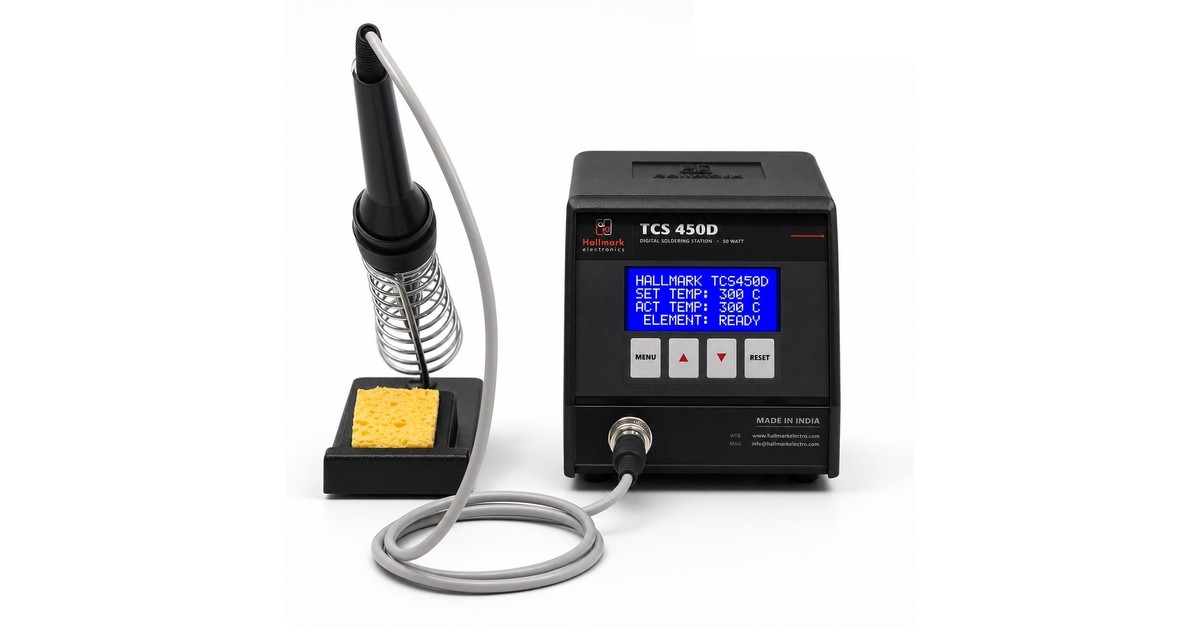
We’re an Indian manufacturer of temperature-controlled soldering equipment, based in Pune since 1987. Our flagship TCS 450 Digital is built for the production benches this article describes — ±2°C stability, microprocessor-controlled, ESD-safe, 1-year warranty, same-week dispatch from Pune.
If you’d like:
– A custom 5-year TCO comparison for your specific line size and product mix
– A 2-week demo unit at your facility (no charge)
– A spec sheet for any of our products
…get in touch and we’ll route the request to the right engineer. No sales pressure attached.
Related guides on Hallmark
- Weller & Hakko alternative in India — TCO compared
Imported vs Indian soldering station — when each genuinely wins. - How to choose a soldering station — 2026 buyer’s guide
Wattage, stability, ESD, tip range — what an Indian procurement team needs to know. - Cold solder joints — 7 root causes and how to fix each
Cold joints are rarely the operator’s fault. The real causes, with fixes. - BGA rework without lifting pads — technician’s playbook
6-step bench protocol that protects pads — preheat, profile, air, prep.