
If you’re sitting in front of a procurement spreadsheet, comparing line items between an imported soldering station from Weller or Hakko and a Made-in-India alternative, this article is written for you.
We’re going to do the comparison honestly. Including the parts where imports legitimately win. Including the parts where Indian manufacturers — including us — still need to grow up. And we’ll show you the 5-year TCO math that most procurement teams don’t run because nobody’s pointed them at the inputs.
By the end you’ll know: when an imported brand is genuinely the right answer, when an Indian manufacturer is the better call, and how to make that decision defensible in front of your finance team.
Why this comparison matters in 2026
For 20 years, “specify Weller or Hakko” has been the default reflex for serious soldering work in India. The reasons were good:
- Documented IPC compliance
- Consistent global build quality
- Familiar to engineers trained abroad
- Defensible in customer audits
In 2026, three forces are pulling that default apart:
-
Make-in-India procurement pressure. Tier-1 OEMs are pushing Make-in-India down their supply chains. Procurement teams at Tier-2 and Tier-3 suppliers are increasingly asked to justify imported equipment when an Indian-made alternative exists.
-
Forex volatility. A station that quoted ₹X eighteen months ago now quotes ₹X+15–20% in INR — before service contracts. Annual rate-contracts have become harder to sign at predictable prices.
-
Service lead times haven’t improved. Heating elements, controllers, replacement irons for imports still take 4–6 weeks via the importer’s reverse-logistics chain. In a production environment, that’s downtime measured in lakhs.
None of this means “always switch to Indian”. It means the decision is now worth running explicitly, line-item by line-item, instead of defaulting on autopilot.
The 5-year TCO comparison (with worked numbers)
The single biggest mistake we see procurement teams make is comparing purchase price. That’s only ~30–35% of total cost of ownership over 5 years.
Here’s a worked example for a typical SMT production line running one station per bench, 8-hour shift, single shift:
| Cost line | Imported (Weller / Hakko equiv) | Indian alternative |
|---|---|---|
| Unit price (1 station, GST inclusive) | ₹85,000 – ₹1,10,000 | ₹38,000 – ₹50,000 |
| Tip replacements (avg 12/year × 5 yr) | ₹18,000 – ₹24,000 | ₹14,000 – ₹18,000 |
| Heating element replacement (1 in 5 yr expected) | ₹12,000 + 4–6 wk wait | ₹3,500 + 5-day delivery |
| Calibration service (annual × 5) | ₹15,000/yr × 5 = ₹75,000 | ₹8,000/yr × 5 = ₹40,000 |
| Operator downtime during failures (estimated) | ₹25,000 over 5 yr | ₹4,000 over 5 yr |
| Forex variance on spares (typical 5-yr) | +12–15% | None |
| 5-year TCO per bench | ~₹2,15,000 – ₹2,55,000 | ~₹99,500 – ₹1,30,000 |
Indicative numbers — the actual figures vary with model, vendor, line size, and shift pattern. The 50–55% TCO gap, however, is consistent across the comparisons we’ve run for production buyers.
For a 10-bench line, the difference is ~₹10–13 lakh over 5 years. For a 50-bench EMS, it’s a number worth a board-level conversation.
Where imports genuinely still win
We’re going to be honest. Three real reasons to specify Weller, Hakko or Metcal in 2026:
1. Customer-mandated brand specification
Some end customers — typically defence, aerospace, or major auto OEMs — explicitly mandate specific brands in their supplier audit checklist. If your customer’s RFP says “stations must be Weller WES51 or equivalent”, and “equivalent” is interpreted strictly, you may not have a choice. (Often there’s wiggle room in how “equivalent” is interpreted — worth asking.)
2. Ultra-fine-pitch BGA / 0201 / SmartHeat applications
Metcal’s SmartHeat technology genuinely does something that no Indian manufacturer (including us) currently matches at the same price point. If you’re doing high-volume rework on 0.4 mm pitch BGAs or 0201 passives at scale, premium imports earn their price.
3. Specific cert / IPC documentation requirements
If your customer audit asks for a chain-of-custody certificate for the station’s calibration history traceable to NABL, and you can’t get an Indian alternative that produces it, the import wins by default.
If none of the above three apply to you — and for the majority of Indian production buyers, they don’t — the comparison opens up.
Where Indian manufacturers (including Hallmark) win
1. Spare parts in days, not weeks
Our Pune factory ships standard spares within 5 working days across India. A heating element on a Weller WX series is typically a 4–6 week wait via the importer. For a production line, that’s the difference between a half-day stop and a half-month stop.
2. Direct manufacturer accountability
When something goes wrong with imported equipment, you’re calling a distributor who’s calling a regional rep who’s emailing the principal. With an Indian manufacturer, you’re calling the people who built the unit. We can have a service engineer on site at most Indian auto-electronics clusters within 48–72 hours.
3. GST + MSME + rate-contract paperwork
Procurement teams know this pain. With imports, you’re managing forex exposure, customs documentation, RBI reporting on payment terms, and a vendor who isn’t on your MSME books. With an Indian manufacturer like us: standard GST invoice, single-PO rate-contract, INR-denominated. (MSME Udyam registration is on our 2026 roadmap — ask us for current status before you commit if your procurement requires it on file.)
4. Full production-line portfolio from one vendor
Most premium imports specialise in stations + tips + a few accessories. Indian manufacturers like Hallmark cover stations + desoldering + solder baths + SMPS + mains-operated irons + production-bath consumables under one PO and one warranty contract. For procurement teams running annual rate-contracts, that’s vendor consolidation in practice.
5. Customisation / private-label capability
Want a station with your line’s branding? A modified front panel for a specific operator workflow? A solder bath sized to your tray geometry? Imports don’t do this. Indian manufacturers can. (We do.)
Where Indian manufacturers, honestly, still need to grow up
We won’t pretend we’re Weller. A few areas where the gap is still real:
- Documentation polish. Premium-import spec sheets are typically more comprehensive than ours. We’re catching up.
- Formal certifications. ISO 9001, CE, RoHS — most Indian manufacturers in our tier (including Hallmark) don’t yet hold these. Expect to see this changing across the segment over the next 12–24 months. If you need a cert today, ask before you commit.
- NABL-traceable calibration. Some Indian manufacturers can provide this; many can’t. Verify per vendor.
- Tip ecosystem breadth. Hakko tip catalogues run to 200+ SKUs. The biggest Indian catalogues are 30–50. For most Indian production work, that breadth is overkill — but for unusual fine-pitch or specialty work, imports are still ahead.
The honest summary: Indian manufacturers have caught up on the 80% of use cases that cover ~95% of production buyers. Imports retain a real edge on the specialist 20% — high-volume fine-pitch rework, defence-cert work, and customer-mandated brand-spec environments.
How to actually run the decision
Six questions, in order:
1. Does any customer / certification require a specific brand?
If yes — done, buy the import.
2. What % of your work is fine-pitch BGA / 0201 / Class 3 IPC?
If >40%, lean toward import. If <40%, Indian is fine.
3. What’s your spare-parts tolerance?
Can you afford a 4–6 week wait when a heating element fails? If no — Indian wins on lead time.
4. What’s your finance team’s view on forex exposure?
If they’re modelling INR weakness over the next 5 years — Indian wins on price predictability.
5. Are you on a Make-in-India procurement mandate from your customer?
If yes — Indian wins by default.
6. Have you actually run the 5-year TCO?
If no — run it. Use our free TCO calculator (linked at the bottom of this page). Most teams that do the math are surprised.
A practical recommendation
For most Indian production buyers in automotive electronics, EMS, panel building, and R&D, the right 2026 strategy is mixed:
- Premium imports for specialist benches — 1–2 high-end stations for the most demanding rework work
- Indian manufacturers for the production majority — 80% of your fleet at 50% the TCO
This gives you the best capability where you need it most, without overpaying for the routine bench. It’s how the most TCO-aware production teams in India actually operate.
Where Hallmark fits
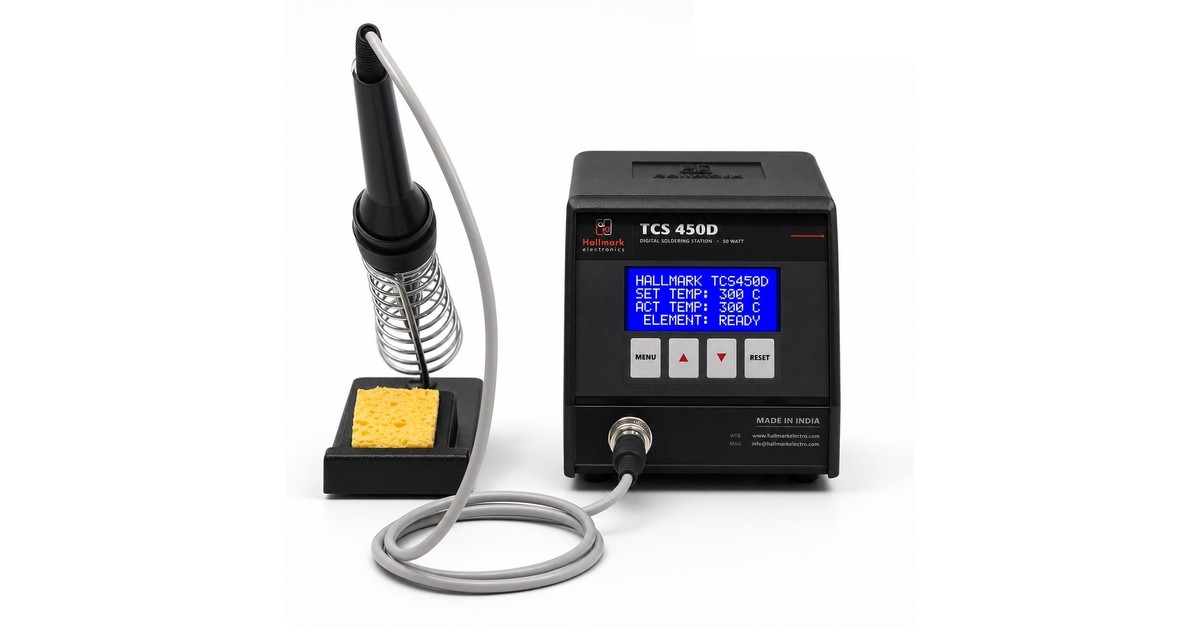
If you’ve read this far, you probably know we make soldering equipment in Pune, manufacturing since 1987. Our flagship is the TCS 450D Series — fully PID-controlled digital soldering stations with ±2°C stability under load, available in 35 W, 50 W, 80 W and 100 W variants. The 50 W is what most production benches use; it sits in the comparison above as the “Indian alternative”.
We aren’t going to claim we’re better than Hakko at everything. We aren’t. But for 80% of the production benches in India, we’ll do the same job for half the lifecycle cost — with spares 5 days from Pune instead of 5 weeks from Yokohama.
If you’d like:
– A spec sheet
– A worked TCO comparison tailored to your line
– A demo unit at your facility for a 1-week trial
– A site visit by one of our engineers
…drop us a note via the contact form or reply directly. We’ll route it to the right engineer. No sales pressure attached.
Related guides on Hallmark
- How to choose a soldering station — 2026 buyer’s guide
Wattage, stability, ESD, tip range — what an Indian procurement team needs to know. - Cold solder joints — 7 root causes and how to fix each
Cold joints are rarely the operator’s fault. The real causes, with fixes. - Imported vs Indian soldering station — real 5-year TCO
Worked numbers, downloadable spreadsheet, an honest method. - BGA rework without lifting pads — technician’s playbook
6-step bench protocol that protects pads — preheat, profile, air, prep.