

Whether you’re buying one bench station for a small lab or 50 stations for a new SMT line, the soldering station you choose will shape your yield, your downtime, and your operator experience for the next 5–8 years.
This guide cuts through the brochure language. We’ll walk through the 12 specs that actually matter for production work, the 8 that look impressive but don’t move the needle, and the questions to ask any vendor before signing a PO.
There’s a free PDF version at the bottom — print it, share it with your team.
Step 1 — Define what the station is actually for
The single biggest mistake we see: buying a generic “good” soldering station without first defining the work it’ll do. Before any spec sheet, answer these:
| Question | Why it matters |
|---|---|
| Production line, R&D, or repair? | Drives wattage, duty cycle, tip range |
| Through-hole, SMD, both? | Drives tip geometry + temperature curve |
| Smallest component package? | Drives tip footprint + thermal accuracy |
| Lead-free, leaded, or both? | Drives temperature ceiling + tip life expectancy |
| Daily duty hours? | Drives heating-element class + cooling design |
| ESD-sensitive components? | Drives ESD-safe certification |
If you can’t answer these in one sentence each, your bench leads need to. A station chosen without these answers is almost always over-spec’d or wrong-spec’d.
Step 2 — The 12 specs that actually matter
1. Power (wattage)
For most modern microprocessor-controlled stations, the headline number is misleading — what matters is how fast the station recovers temperature under load, not the peak wattage.
- Hobbyist work: 30–60W is fine
- Bench repair / R&D: 60–100W
- SMD production (passives + ICs): 80–150W
- Through-hole production (large pads, ground planes): 150–250W
- Heavy production / wave-prep: 300–450W
A 450W station with poor closed-loop control is worse than a 100W station with tight control. Ask for idle-to-load recovery time (how fast does it return to setpoint after a thermal-mass touch?). Anything under 5 seconds is good. Over 10 seconds means slow benches.
2. Temperature stability under load
The single most important spec, and the one most often misrepresented.
A station spec’d at “±2°C” should hold ±2°C under load — not just at idle on the stand. Ask the vendor: “What’s the drift when the tip touches a 3 mm copper pad?” If they don’t have an answer, walk away.
Production-grade target: ±2°C under load. Hobbyist-grade is typically ±10–15°C, even when the brochure says “temperature-controlled”.
3. Tip ecosystem
You’ll buy 5–10× more tips than stations over the station’s life. Tip range determines whether the bench can handle every job thrown at it.
Verify:
– How many tip geometries are available? (At least 8–10 for a production station)
– What’s the tip footprint compatibility? (Will industry-standard tips fit?)
– Is there a fine-conical tip for 0402 / 0201 work?
– Is there a wide chisel for ground-plane work?
A narrow tip range means you’ll either work around limitations or buy a second station.
4. ESD safety
If your bench touches any IC manufactured after 2010, you need ESD-safe equipment. Period.
Verify:
– ESD-safe rating on the station body and the iron grip
– Resistance specification (typically 1 MΩ to 100 GΩ)
– Equipotential bonding to bench mat
Don’t just trust a “ESD-safe” label — ask for the resistance test certificate per unit.
5. Closed-loop control architecture
Microprocessor-controlled stations with thermocouple or RTD feedback at the tip are the modern standard. Older “analog” stations rely on bimetallic switches and have inherent ±10–15°C drift.
For any production work — digital. No exception.
6. Tip change without cooldown
Production benches that have to wait 60 seconds for the tip to cool before changing geometry lose dozens of minutes per shift. Modern stations have quick-change tip cartridges that swap hot.
Verify: tip-change procedure on the actual unit, not just the brochure.
7. Stand / cradle ergonomics
Operator fatigue across an 8-hour shift is real. A poor cradle position causes wrist strain; a hot-tip drift onto a sleeve causes burns. Surprisingly few buyers actually try the cradle before buying.
Ask for an in-person demo or sample unit before committing to large orders.
8. Thermal cleaning system
Tip life depends on tip cleaning. Brass-wool cleaners last longer and damage tips less than wet sponges, but require space on the bench. Built-in cleaners are convenient but often poorly designed.
Verify: which cleaner the station defaults to, and whether you can fit your preferred cleaner adjacent.
9. Calibration interface
Production benches under IPC-A-610 process audit need calibration logs. The station should support either:
– External temperature probe calibration (manual log)
– Built-in calibration mode with USB / display output
For NABL-traceable certification (if your customer requires), ask whether the manufacturer provides this — most Indian manufacturers don’t yet, most premium imports do.
10. Warranty + serviceability
12 months is the table-stakes warranty — anything less is a red flag. What matters more:
- Spare parts lead time when the unit breaks (5 days vs 5 weeks)
- Heating element availability in 2–5 years (manufacturers can discontinue product lines)
- Authorised service centres in your region
- Annual calibration service availability
11. Power supply input range
Indian power quality varies. A station that doesn’t tolerate ±15% voltage variance will fail in industrial environments where load voltage swings under heavy machinery loads.
Verify: input voltage tolerance. Industrial-grade should be 175–270V AC.
12. Total cost of ownership over 5 years
Purchase price is ~30–35% of total cost over a 5-year life. The rest is tips, calibration, downtime, spares, and operator productivity.
Run the TCO calculation before comparing purchase prices. We’ve worked an example in our imported vs Indian 5-year TCO post — the headline numbers may surprise you.
Step 3 — The 8 specs that look impressive but barely matter
Save your evaluation time and skip these:
- Maximum temperature ratings above 480°C. Lead-free work tops out around 360°C; higher numbers are marketing.
- “Fast heat-up time” claimed in seconds. A station heats up once per shift. Heat-up time matters less than recovery-under-load.
- LED display style / colour / animation. Vendors love this; production teams ignore it.
- Built-in timer / sleep modes. Useful but trivial — every modern station has them.
- Touch-screen interface. Looks slick; production benches don’t need it.
- Brand name on the unit. A familiar name on the front panel doesn’t change the joint quality.
- Imported origin badge. Origin doesn’t determine fitness for purpose; specs do.
- Bundled accessories. “Comes with 5 tips and a sponge!” — verify the tips are the geometries you need; otherwise the bundle is filler.
Step 4 — Vendor evaluation questions
Before signing a PO with any vendor, get written answers to:
- What’s the spare-parts lead time for heating elements, controllers, and tips?
- Where’s the nearest authorised service centre?
- What’s the calibration service interval and cost?
- Will the model be available in 5 years? (For multi-year rate contracts.)
- What’s the warranty claim process — replacement-first, or repair-first?
- Are there volume / loyalty discounts on consumables?
- Can we have a demo unit for a 2-week trial?
A vendor who can’t answer these clearly is a vendor who hasn’t thought about the customer’s life beyond the sale.
Step 5 — Indian vs imported
For most Indian production buyers, the right call in 2026 is a mixed fleet:
- 1–2 premium imports for specialist rework / fine-pitch / Class-3 IPC work
- 80% Indian manufacturers for the routine production majority
The deeper analysis is in our Weller / Hakko alternative comparison. Short version: TCO advantage of Indian manufacturers is typically 50–55% over 5 years, with spare-parts lead time being the second decisive factor after price.
A worked example
A small EMS in Coimbatore, 30 production benches, single shift, mixed SMD + through-hole work, lead-free, ESD-sensitive components.
Their decision logic:
| Step | Decision |
|---|---|
| Production line, mixed SMD + TH | 80–150W class digital station |
| Smallest package = 0603 SMD | Standard fine tip range needed; no exotic 0201 |
| Lead-free | 350–360°C operating range |
| ESD-sensitive | ESD-safe variant mandatory |
| 8-hour shift | Production-grade duty cycle |
| Customer audit = IPC-A-610 Class 2 | ±2°C stability sufficient |
| No specific brand mandate from customer | Indian manufacturer in scope |
| 30 benches × 5-year TCO | Indian alternative saves ~₹35 lakh over 5 years |
Their final spec: a 450W microprocessor-controlled ESD-safe digital station from a Pune manufacturer, with 1 premium import station kept on the QA bench for occasional fine-pitch rework.
That’s a typical, defensible 2026 procurement decision.
Free downloadable PDF
We’ve packaged this guide as a printable A4 PDF — including the 12-spec checklist, the 8-spec ignore-list, and the vendor evaluation questions. Free, no upselling.
📎 Download the buying guide PDF (gated — name + email only)
Where Hallmark fits
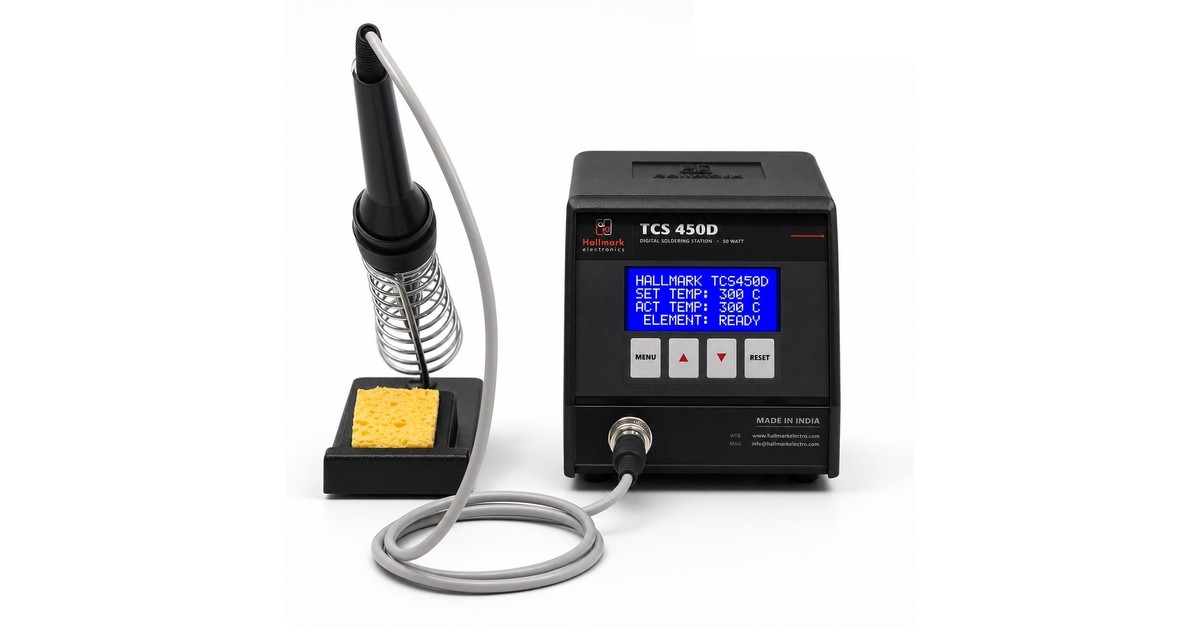
If you’re evaluating Indian manufacturers, we’d be honest enough to say: yes, look at us, and yes, look at others too. Our flagship TCS 450 Digital meets every spec discussed above for production-grade SMD/TH work. We’ve been making this kind of equipment in Pune since 1987.
If you’d like a spec sheet for any of our products, or a 2-week demo unit at your facility, drop us a note and we’ll route it to the right engineer. No sales pressure attached.
Related guides on Hallmark
- Weller & Hakko alternative in India — TCO compared
Imported vs Indian soldering station — when each genuinely wins. - Cold solder joints — 7 root causes and how to fix each
Cold joints are rarely the operator’s fault. The real causes, with fixes. - Imported vs Indian soldering station — real 5-year TCO
Worked numbers, downloadable spreadsheet, an honest method. - BGA rework without lifting pads — technician’s playbook
6-step bench protocol that protects pads — preheat, profile, air, prep.